
Every body processes food differently — and Ayurveda has known this for thousands of years. Long before modern science began exploring personalised nutrition and nutrigenomics, Ayurvedic nutrition offered a complete system for eating according to your individual constitution. Rather than prescribing a universal diet, it asks a more fundamental question: who is eating? The answer — your unique combination of the three doshas — determines not just what you should eat, but how, when, and in what combinations.
The Foundation: Agni, Ama, and Why Digestion Comes First
In Ayurveda, nutrition does not begin with the food on your plate — it begins with the fire in your belly. Agni, the digestive fire, is considered the root of health, longevity, and immunity. The Charaka Samhita — one of Ayurveda's foundational texts — states that a person with balanced agni can extract nourishment even from ordinary food, while a person with impaired agni will struggle to digest even the finest meal.
When agni is weak, food is not fully metabolised. The residue that remains is called ama — a heavy, sticky, toxic substance that Ayurveda considers the root cause of most disease. Ama accumulates in the digestive tract, blocks the body's channels (srotas), and disturbs dosha balance. This is why Ayurvedic dietary rules — collectively known as Ahara Vidhi Vidhana — focus as much on how you eat as on what you eat: eat warm food, eat only when the previous meal is digested, eat in proper quantity, and eat with full attention.
The Six Tastes: Ayurveda's Nutritional Framework
Where modern nutrition classifies food by macronutrients, vitamins, and calories, Ayurveda classifies food by rasa — taste. There are six tastes (shad rasa), each composed of two of the five elements, and each with a direct effect on the doshas:
| Taste | Sanskrit | Elements | Increases | Decreases |
|---|---|---|---|---|
| Sweet | Madhura | Earth + Water | Kapha | Vata, Pitta |
| Sour | Amla | Earth + Fire | Pitta, Kapha | Vata |
| Salty | Lavana | Water + Fire | Pitta, Kapha | Vata |
| Pungent | Katu | Air + Fire | Vata, Pitta | Kapha |
| Bitter | Tikta | Air + Ether | Vata | Pitta, Kapha |
| Astringent | Kashaya | Air + Earth | Vata | Pitta, Kapha |
The classical principle is straightforward: a balanced meal includes all six tastes, but the proportion shifts based on your dominant dosha. You emphasise the tastes that pacify your constitution and moderate the tastes that aggravate it. Most modern diets rely heavily on just sweet and salty — leaving us physically full but energetically unsatisfied. Incorporating all six tastes ensures the body receives the signal that complete nutrition has arrived, which naturally prevents overeating.
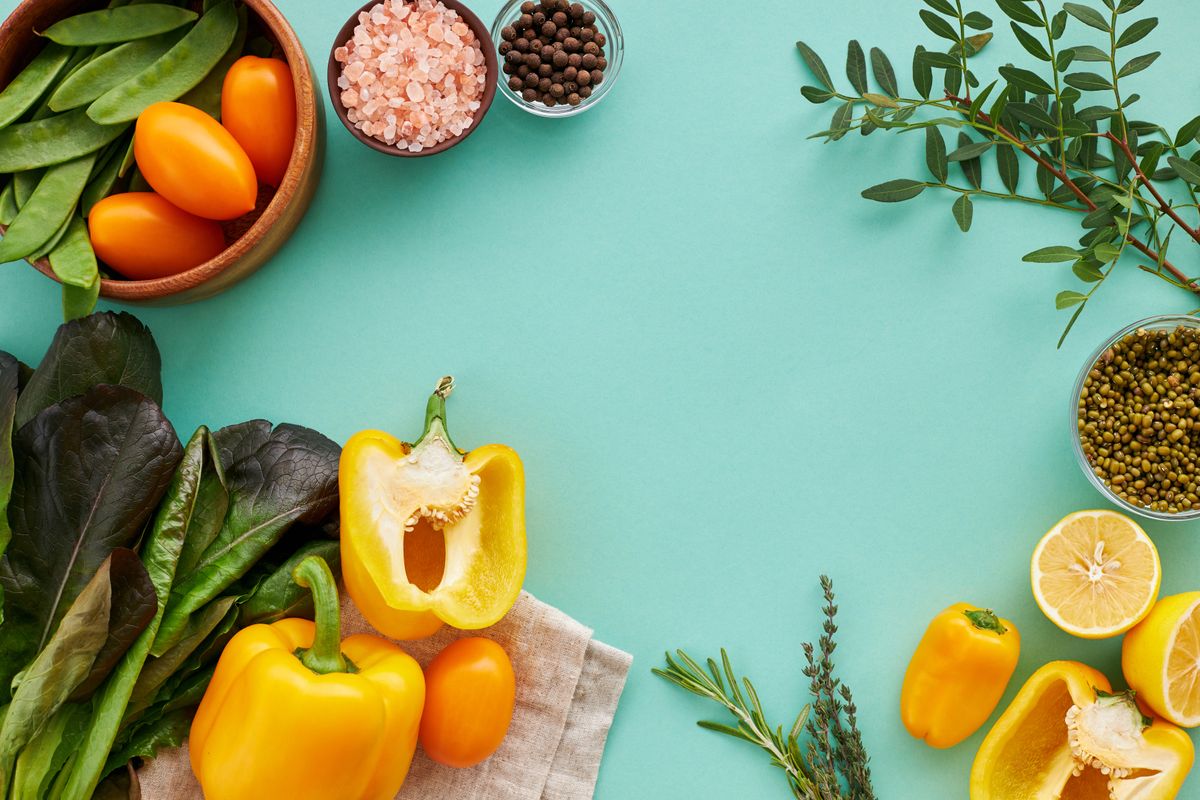 Fresh vegetables, herbs, and spices arranged in colourful bowls on a teal background, representing the variety of an Ayurvedic diet
Eating for Your Dosha: A Practical Guide
Each dosha has distinct qualities, and the dietary strategy is to counter those qualities with their opposites through food. This is the principle of samanya-vishesha — like increases like, and opposites create balance.
Vata (Air + Ether): Warm, Moist, and Grounding
Vata is cold, dry, light, mobile, and irregular. When aggravated, it manifests as bloating, gas, anxiety, insomnia, and dry skin. The Vata-pacifying diet emphasises the opposite qualities: warm, moist, heavy, and stable.
- Favour: Cooked grains (rice, oats, wheat), root vegetables (sweet potato, beetroot, carrot), soups, stews, ghee, sesame oil, warm milk, ripe sweet fruits, and warming spices (ginger, cumin, cinnamon, cardamom, asafoetida)
- Reduce: Raw salads, cold smoothies, dried fruits in excess, beans (except mung), carbonated drinks, and highly bitter or astringent foods
- Key tastes: Sweet, sour, and salty
- Meal rhythm: Regular, consistent meal times — Vata is most disturbed by irregularity
Pitta (Fire + Water): Cool, Mild, and Soothing
Pitta is hot, sharp, oily, and intense. When aggravated, it manifests as acid reflux, inflammation, skin rashes, irritability, and excessive hunger. The Pitta-pacifying diet emphasises cooling, mildly seasoned, and calming foods.
- Favour: Sweet fruits (grapes, melons, pomegranate), leafy greens, cucumber, courgette, coconut, basmati rice, wheat, ghee, milk, coriander, fennel, mint, and turmeric in moderation
- Reduce: Hot chillies, fermented foods, sour citrus, tomatoes, garlic, onion, vinegar, alcohol, and excessive salt
- Key tastes: Sweet, bitter, and astringent
- Meal rhythm: Never skip meals — Pitta's strong agni creates genuine hunger that, unsatisfied, turns to irritability
Kapha (Earth + Water): Light, Warm, and Stimulating
Kapha is heavy, cool, oily, slow, and stable. When aggravated, it manifests as weight gain, lethargy, congestion, water retention, and emotional attachment. The Kapha-pacifying diet emphasises light, dry, warm, and stimulating foods.
- Favour: Leafy greens, legumes (lentils, chickpeas), millet, barley, corn, pungent spices (ginger, black pepper, mustard seed, cayenne), light fruits (apples, pears, berries), honey in small amounts, and steamed vegetables
- Reduce: Dairy (especially cheese and ice cream), wheat, fried foods, sweet desserts, excess oil, nuts in large quantities, and cold, heavy meals
- Key tastes: Pungent, bitter, and astringent
- Meal rhythm: Two substantial meals may be sufficient — Kapha does not require three full meals if appetite is not present
The Science Behind Dosha-Based Nutrition
The idea that people of different constitutional types respond differently to food is no longer purely philosophical. A landmark study from the Centre for Cellular and Molecular Biology (CCMB) in India analysed genome-wide SNP data from 262 individuals classified by their dominant dosha. The researchers identified 52 single nucleotide polymorphisms (SNPs) that could distinguish Vata, Pitta, and Kapha constitutions — the first genome-wide evidence that Ayurveda's phenotypic classification has a measurable genetic basis.
An earlier whole-genome expression study published in the Journal of Translational Medicine (2008) found that individuals of the three extreme constitutional types exhibited significant differences in biochemical profiles — including liver function tests, lipid profiles, and haematological parameters — as well as in gene expression levels for genes involved in immunity, cell division, and blood coagulation.
In clinical nutrition specifically, a 2021 randomised controlled trial published in Frontiers in Medicine compared Ayurvedic nutritional therapy head-to-head with conventional dietary therapy (including the low-FODMAP diet) for patients with irritable bowel syndrome (IBS). The study, conducted at the Charité University Hospital in Berlin, found that the Ayurvedic approach was as effective as the conventional treatment in reducing IBS symptoms — a significant finding, given that the low-FODMAP diet is currently considered the gold-standard nutritional intervention for IBS.
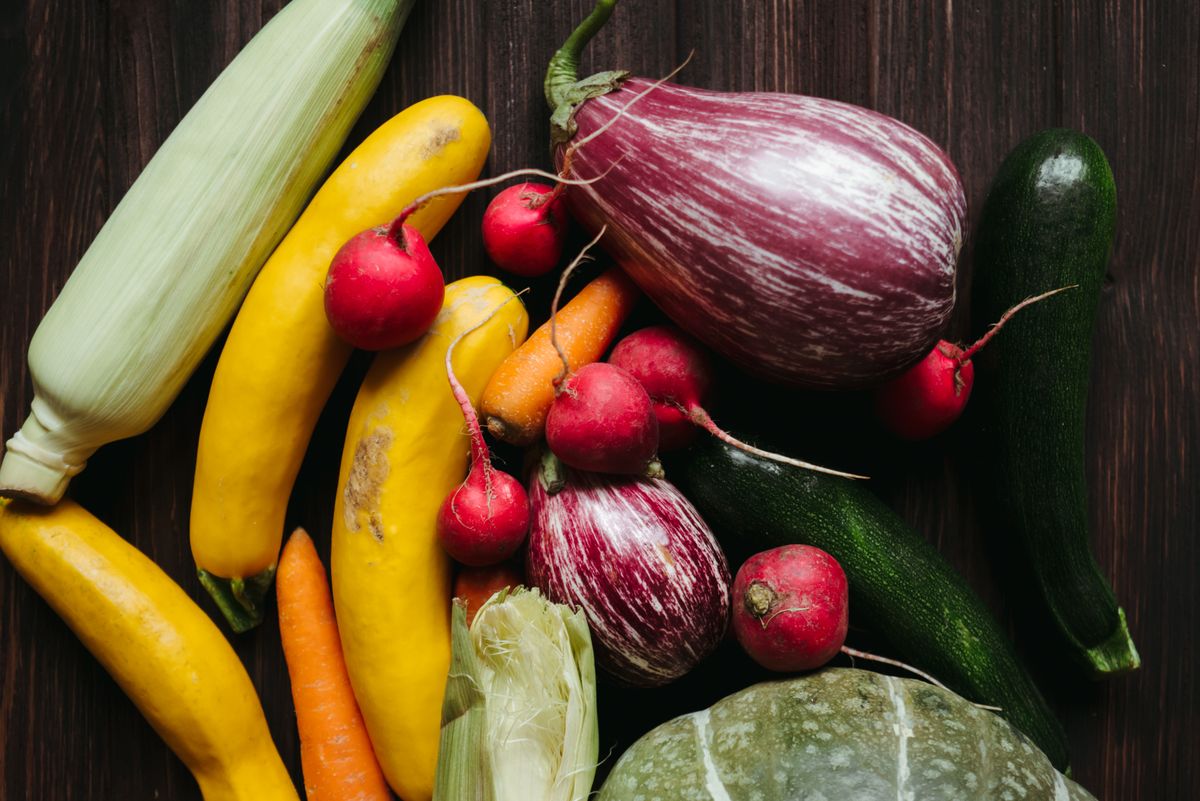 A vibrant spread of fresh colourful vegetables on a dark wooden surface, evoking the wholesome diversity of a dosha-balanced meal
Classical Rules for How to Eat
Ayurvedic nutrition is not only about what to eat — the Ahara Vidhi Vidhana (dietary code of conduct) from the Charaka Samhita prescribes equally precise rules for how food should be consumed:
- Eat warm food (ushna) — warm food stimulates agni and is digested more easily
- Eat unctuous food (snigdha) — adequate healthy fats (ghee, oil) nourish the tissues and satisfy hunger
- Eat in proper quantity (matravata) — the stomach should be filled one-third with food, one-third with liquid, and one-third left empty
- Eat only after the previous meal is digested (jirne ashniyat) — eating before the prior meal is processed creates ama
- Eat foods with compatible qualities — certain combinations, called Viruddha Ahara (incompatible foods), disrupt digestion; classic examples include fish with milk, or fruit with meals
- Eat in a pleasant environment, with attention — distracted eating weakens agni and impairs absorption
- Eat neither too quickly nor too slowly — eating too fast prevents proper chewing and enzyme mixing; eating too slowly allows food to cool
- Do not eat while laughing or talking excessively — this introduces excess air (Vata) into the digestive process
These rules may seem simple, but they address the most common dietary errors in modern life: eating while distracted, eating before the previous meal has digested, and relying on cold, processed, or improperly combined foods.
A Way of Listening
Ayurvedic nutrition is not a restrictive diet — it is a framework for listening to the body's intelligence and responding with appropriate nourishment. It does not ask you to eliminate food groups or count macronutrients. It asks you to observe your constitution, assess your current state, and choose foods whose qualities restore balance. The emerging science of Ayurnutrigenomics — bridging classical constitutional typing with modern genomics — suggests that this ancient system was right all along: nutrition is deeply personal, and the most effective diet is the one designed for your body.
Sources & Further Reading
Research
- Prasher, B. et al. (2008). Whole Genome Expression and Biochemical Correlates of Extreme Constitutional Types Defined in Ayurveda. Journal of Translational Medicine. View on PMC
- Govindaraj, P. et al. (2015). Genome-Wide Analysis Correlates Ayurveda Prakriti. Scientific Reports. View on Nature
- Jeitler, M. et al. (2021). Ayurvedic vs. Conventional Nutritional Therapy Including Low-FODMAP Diet for Patients With Irritable Bowel Syndrome — A Randomized Controlled Trial. Frontiers in Medicine. View on PMC
- Dey, S. & Pahwa, P. (2014). Prakriti and Its Associations with Metabolism, Chronic Diseases, and Genotypes: Possibilities of New-Born Screening and a Lifetime of Personalised Prevention. Journal of Ayurveda and Integrative Medicine. View on PMC
- Rotti, H. et al. (2015). Ayurnutrigenomics: Ayurveda-Inspired Personalised Nutrition from Inception to Evidence. Journal of Traditional and Complementary Medicine. View on PMC
Further Reading
- Ahara Vidhi — Charaka Samhita Online
- A Review Article on Ahara Vidhi Vidhana — Journal of Indian System of Medicine
- The Six Tastes in Ayurveda — Banyan Botanicals
Image Credits
- Cover: Spices on a dark background — Pexels
- Fresh fruits and vegetables on a teal background — Pexels
- Fresh colourful vegetables on table — Pexels
All images free to use under the Pexels License.