Long before the modern beauty industry existed, the Ayurvedic practitioners of ancient India had already developed a comprehensive system of skin care — one that treated the skin not as a surface to be corrected, but as a living mirror of internal health. Rooted in texts dating back to the Indus Valley Civilisation (3300–1300 BCE), Ayurvedic skin care combines herbal formulations, oil rituals, and constitutional awareness into a practice that modern dermatology is only now beginning to validate through clinical research.
Your Skin's Dosha: The Foundation of Ayurvedic Beauty
In Ayurveda, healthy skin begins with understanding your Prakriti — your unique constitutional type governed by the three doshas. Each dosha produces a distinct skin type with its own strengths, vulnerabilities, and care requirements.
| Dosha | Skin Characteristics | Common Imbalances | Ideal Care Approach |
|---|---|---|---|
| Vata | Thin, dry, fine-pored, cool to touch | Flakiness, premature fine lines, dullness | Deep nourishment with warm, heavy oils |
| Pitta | Warm, sensitive, medium-textured, fair | Redness, rosacea, acne, photosensitivity | Cooling herbs and gentle, soothing formulations |
| Kapha | Thick, oily, large-pored, resilient | Congestion, cystic acne, blackheads | Stimulating, detoxifying, and astringent treatments |
The Charaka Samhita teaches that skin disorders arise when Bhrajaka Pitta — the subdosha governing skin lustre and pigmentation — becomes imbalanced. This is why Ayurvedic skin care always begins internally: addressing diet, digestion, and emotional state before reaching for any topical remedy.
Varnya Gana: The Complexion-Enhancing Herbs
The classical Ayurvedic texts describe a group of herbs known as the Varnya Gana — the "complexion enhancers." These plants, documented in the Charaka Samhita and the Ashtanga Hridayam, form the foundation of every traditional Ayurvedic beauty preparation.
-
Manjistha (Rubia cordifolia) — The premier blood-purifying herb in Ayurveda. It supports liver function and clears toxins from Rakta Dhatu (blood tissue), addressing skin conditions at their root. Traditionally used for hyperpigmentation, acne scarring, and uneven tone.
-
Chandana (Sandalwood) — Cooling, anti-inflammatory, and astringent. Sandalwood has been used for centuries to calm Pitta-type skin irritation. A Phase 2 clinical trial of East Indian Sandalwood Oil demonstrated efficacy in treating atopic dermatitis, while a separate study found that a sandalwood-turmeric cream significantly delayed the onset of radiation dermatitis in cancer patients.
-
Haridra (Turmeric) — The golden herb whose active compound curcumin has been studied in 19 clinical trials for dermatological conditions. A systematic review found that 1% topical curcumin resolved psoriasis by up to 90% in some patients within 2–6 weeks.
-
Kumkuma (Saffron) — Revered as the most precious Varnya herb, saffron promotes radiance and even skin tone. It is a key ingredient in classical formulations like Kumkumadi Tailam, one of Ayurveda's most celebrated facial oils.
-
Amalaki (Indian Gooseberry) — One of the richest natural sources of vitamin C, Amalaki supports collagen synthesis and protects against oxidative damage. It is a component of Triphala, the Ayurvedic formula used internally to support digestion and clear the skin from within.
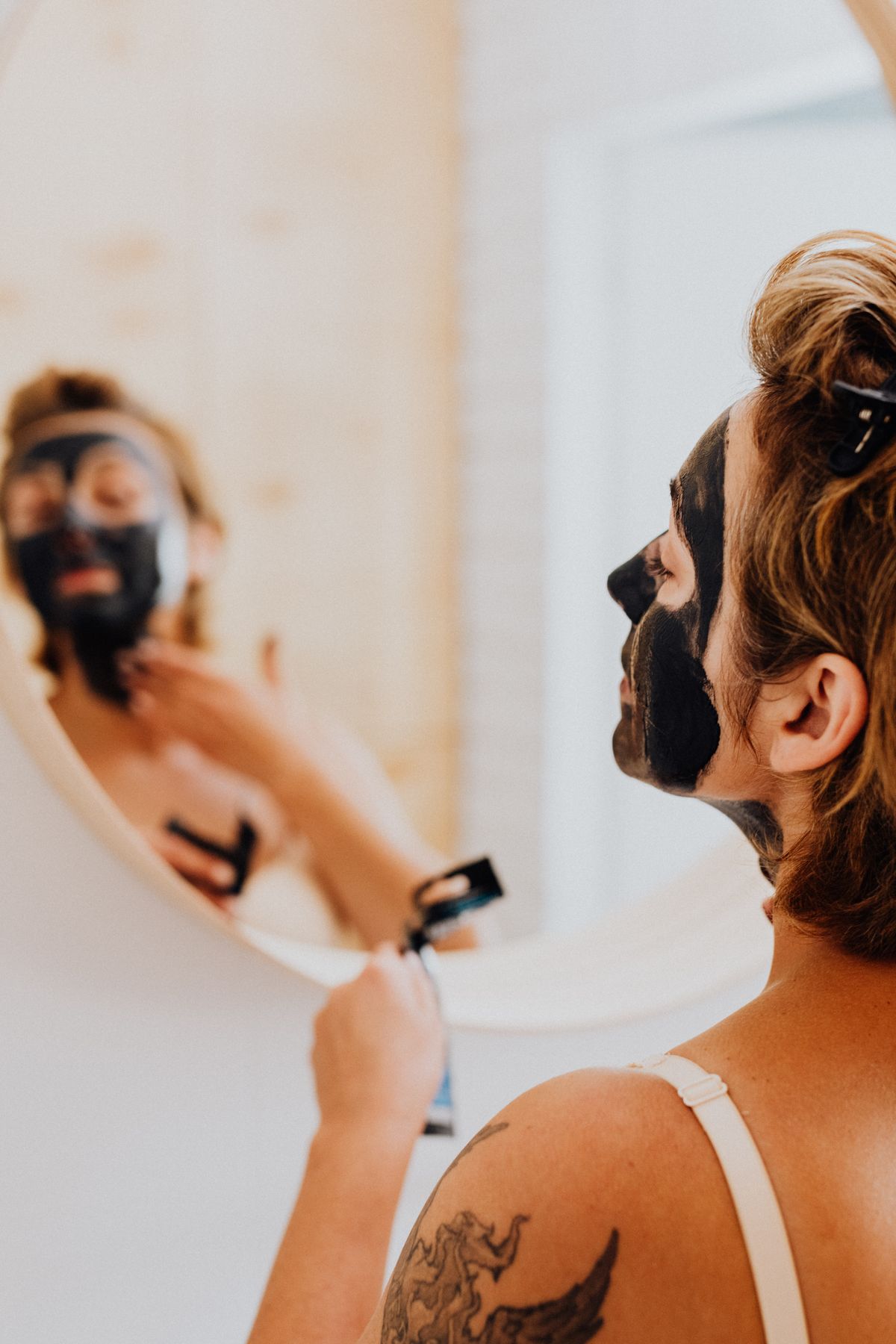 Woman enjoying a natural skincare routine, applying facial serum in a bright setting
Ubtan: The Sacred Herbal Face Pack
Ubtan is perhaps the most iconic beauty ritual in the Ayurvedic tradition. The name derives from the Sanskrit Udvartana, meaning "to cleanse and adorn," and the practice is described in the Bhaishajya Ratnavali and the Charaka Samhita for its Varnya (complexion-enhancing) and Rasayana (rejuvenating) properties.
A traditional ubtan combines:
- Chickpea flour (besan) — gentle exfoliation and oil absorption
- Turmeric — antioxidant protection and skin brightening
- Sandalwood powder — cooling, anti-inflammatory, and fragrant
- Rose water — natural toner and hydration
The mixture is made into a paste and applied to the face and body, left for 15–20 minutes, then gently rubbed off with water. Unlike modern chemical exfoliants, ubtan cleanses without stripping the skin's natural oils.
The ubtan can be customised for each dosha:
- Vata skin — add warm milk, honey, or ghee for deep nourishment
- Pitta skin — add rose water or aloe vera gel for cooling relief
- Kapha skin — add lemon juice or tulsi (holy basil) water for detoxification
Abhyanga for the Face: Oil Rituals by Constitution
Abhyanga — the Ayurvedic practice of warm oil massage — extends to the face as a daily beauty ritual. Facial abhyanga nourishes the skin, stimulates lymphatic drainage, and calms the nervous system through the activation of Marma points (vital energy centres) on the face.
The choice of oil depends entirely on the dosha:
| Dosha | Recommended Oils | Why |
|---|---|---|
| Vata | Sesame oil, almond oil, ashwagandha-infused oil | Warm, heavy oils counteract Vata's cold, dry quality |
| Pitta | Coconut oil, sunflower oil, Kumkumadi Tailam | Cooling oils soothe Pitta's heat and inflammation |
| Kapha | Jojoba oil, grapeseed oil, neem-infused oil | Light, non-comedogenic oils avoid Kapha congestion |
The technique involves warming a small amount of oil between the palms, then gently massaging the face in upward, circular motions — starting at the chin and moving toward the forehead, spending extra time on the temples and jawline. A 2025 paper in the Journal of Cosmetic Dermatology noted that small clinical trials have already demonstrated that topical ashwagandha lotion can improve photoaged skin and reduce transepidermal water loss — validating one of Ayurveda's most traditional skincare oils.
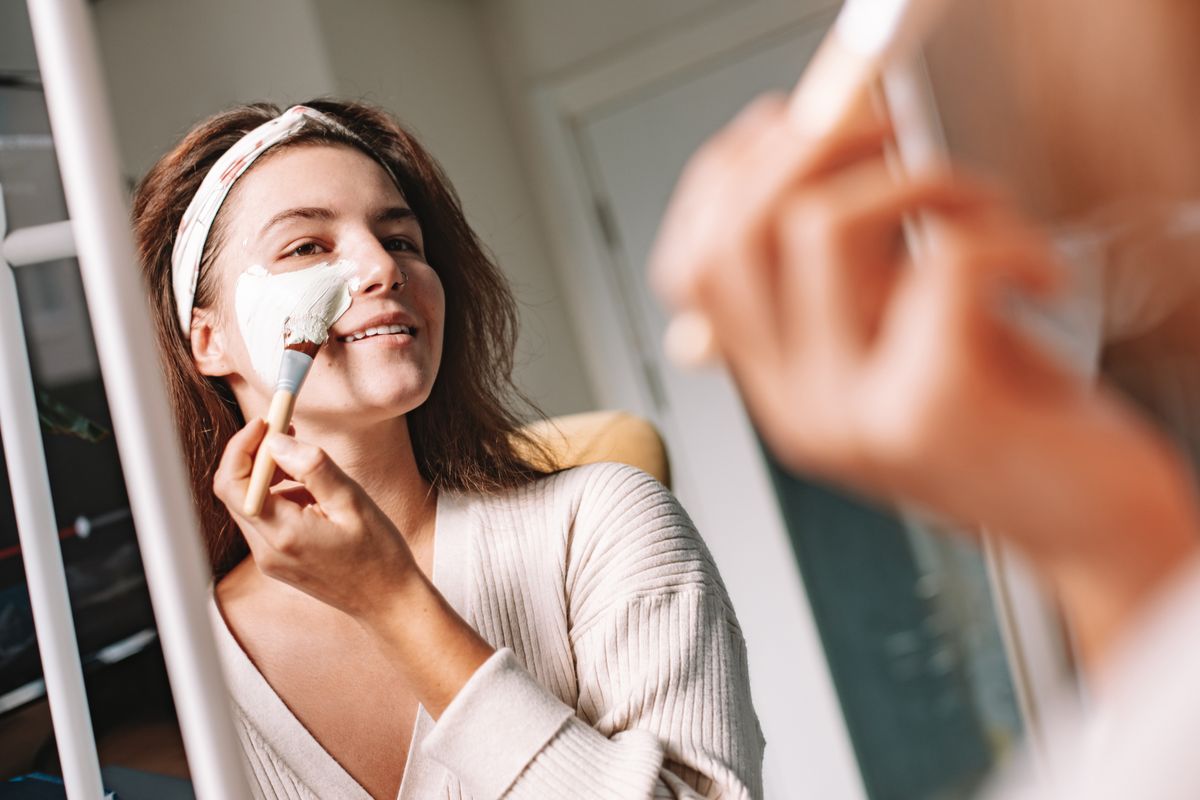 Woman applying a herbal face mask in front of a mirror as part of her beauty ritual
What Modern Research Confirms
While Ayurvedic skin care has millennia of empirical evidence, modern clinical research is now catching up. A landmark 2023 systematic review published in Skin Pharmacology and Physiology examined 19 clinical trials on topical curcumin across conditions including psoriasis, vitiligo, scabies, and skin ageing:
- Psoriasis: Double-blind placebo-controlled trials showed PASI scores improved 61% with turmeric versus 11% with placebo
- Skin infections: A study of 814 patients found that a turmeric and neem paste achieved a 97.9% cure rate for scabies
- Vitiligo: A randomised double-blind trial of 24 patients reported improvement in 58% of treated lesions
- Alopecia: Curcumin combined with piperine and capsaicin performed comparably to minoxidil, with both groups showing ~57% improvement
A 2025 review by Singh et al. in the Journal of Cosmetic Dermatology — titled "Ayurvedic Ingredients in Dermatology: A Call for Research" — identified ashwagandha, turmeric, saffron, neem, sandalwood, aloe, and tulsi as the ingredients most deserving of rigorous clinical investigation. The authors acknowledged that while "centuries of anecdotal evidence" support these ingredients, modern validation through larger-scale randomised controlled trials is essential.
Building Your Daily Ayurvedic Skin Care Ritual
The beauty of Ayurvedic skin care lies in its simplicity. A complete daily practice requires no expensive products — only a few natural ingredients chosen for your constitution:
- Morning cleanse — Wash with a gentle ubtan paste instead of commercial cleanser
- Facial abhyanga — Apply 3–5 drops of dosha-appropriate oil and massage for 2–3 minutes
- Hydrate internally — Drink warm water with lemon (Pitta/Kapha) or warm water with ginger (Vata) on an empty stomach
- Weekly ubtan mask — Apply a full ubtan face pack once or twice per week for deeper exfoliation and brightening
- Support from within — Include Triphala or Manjistha as part of your herbal regimen to address skin health at the level of digestion and blood purity
The Ayurvedic approach asks us to see the skin not as a problem to be solved, but as a living landscape that reflects our inner state. When we nourish the body with the right foods, calm the mind with appropriate practices, and honour the skin with herbs that have been trusted for five thousand years, radiance is not something we apply — it is something that emerges.
Sources & Further Reading
Research
- Singh, S. et al. (2025). Ayurvedic Ingredients in Dermatology: A Call for Research. Journal of Cosmetic Dermatology. View on PMC
- Vollono, L. et al. (2023). Clinical Studies on Topical Curcumin. Skin Pharmacology and Physiology, 36(5), 235–248. View on Karger
- Thanawala, S. et al. (2025). Efficacy and Safety of an Oral Low-Dose Water-Dispersible Turmeric Extract Capsule on Facial Skin Health in Healthy Women. Journal of Cosmetic Dermatology. View on Wiley
- Dwivedi, V. et al. (2017). Sandalwood Oil and Turmeric-Based Cream Prevents Ionizing Radiation-Induced Dermatitis in Breast Cancer Patients: Clinical Study. Indian Journal of Palliative Care, 23(4). View on PMC
- Zaman, S. U. & Akhtar, N. (2021). Cosmetic and Dermatological Properties of Selected Ayurvedic Plant Extracts. Archives of Dermatological Research, 313, 613–628. View on PubMed
Further Reading
- Ayurvedic Skincare Rituals: Ancient Indian Beauty Secrets — Fevour Cosmetics
- A Guide to Ayurvedic Skin Care — Healthline
- Ayurvedic Skincare for Glowing Skin — The Ayurvedic Institute
- Ubtan: Ayurvedic Secret for Glowing Skin — Forest Essentials
Image Credits
- Cover: Artisan natural skincare in cozy flatlay — Pexels
- Woman doing her skincare routine — Pexels
- Woman applying face mask in mirror — Pexels
All images free to use under the Pexels License.