
In Ayurveda, there is no such thing as a one-size-fits-all prescription for health. Every dietary recommendation, herbal protocol, and daily routine begins with a single question: what is your Prakriti? Your Prakriti — your innate Ayurvedic body type — is the foundation upon which all personalised healing rests. Discovering it is not a trivial exercise; it is the most important step you can take toward understanding your own body and mind.
What Prakriti Really Means
The Sanskrit word Prakriti derives from pra (original, first) and kriti (creation). It refers to your original nature — the unique ratio of Vata, Pitta, and Kapha doshas that was established at the moment of your conception. This ratio is influenced by your parents' constitutions, their state of health at the time of conception, the season, and even the quality of the food your mother consumed during pregnancy.
Classical Ayurvedic texts describe seven main Prakriti types: three single-dosha types (Vata, Pitta, Kapha), three dual-dosha types (Vata-Pitta, Pitta-Kapha, Vata-Kapha), and the rare tri-doshic constitution where all three doshas exist in near-equal proportion. In practice, roughly 80% of people are dual-dosha types, about 10% are single-dosha dominant, and the remaining 10% are tri-doshic.
What makes Prakriti so central to Ayurveda is a principle that applies to everything from food to medicine: what heals one person may harm another. A warming, spicy diet that grounds a cold, anxious Vata type would aggravate an already fiery Pitta constitution. Without knowing your Prakriti, any health advice is a guess.
Prakriti vs. Vikriti: The Critical Distinction
One of the most common mistakes — both in self-assessment and in casual Ayurvedic practice — is confusing Prakriti with Vikriti.
| Aspect | Prakriti | Vikriti |
|---|---|---|
| Definition | Your inborn, fixed constitution | Your current state of imbalance |
| Stability | Constant throughout life | Shifts with diet, lifestyle, season, and stress |
| Determined by | Genetics and conditions at conception | External factors and accumulated habits |
| Role in treatment | Baseline for understanding your nature | Target for therapeutic intervention |
| Example | A naturally slender frame and creative mind (Vata prakriti) | Weight gain and lethargy due to sedentary lifestyle (Kapha vikriti) |
The goal of Ayurvedic treatment is never to change your Prakriti — it is to bring your Vikriti back into alignment with your Prakriti. A person with a Vata constitution who has developed Kapha-type symptoms does not need a Kapha-balancing protocol for life; they need it temporarily until balance is restored, and then a Vata-supportive lifestyle to maintain it.
This distinction is why self-assessment alone is limited. If you have lived with a particular imbalance for years or decades, it can feel like your natural state — masking your true Prakriti beneath layers of accumulated vikriti.
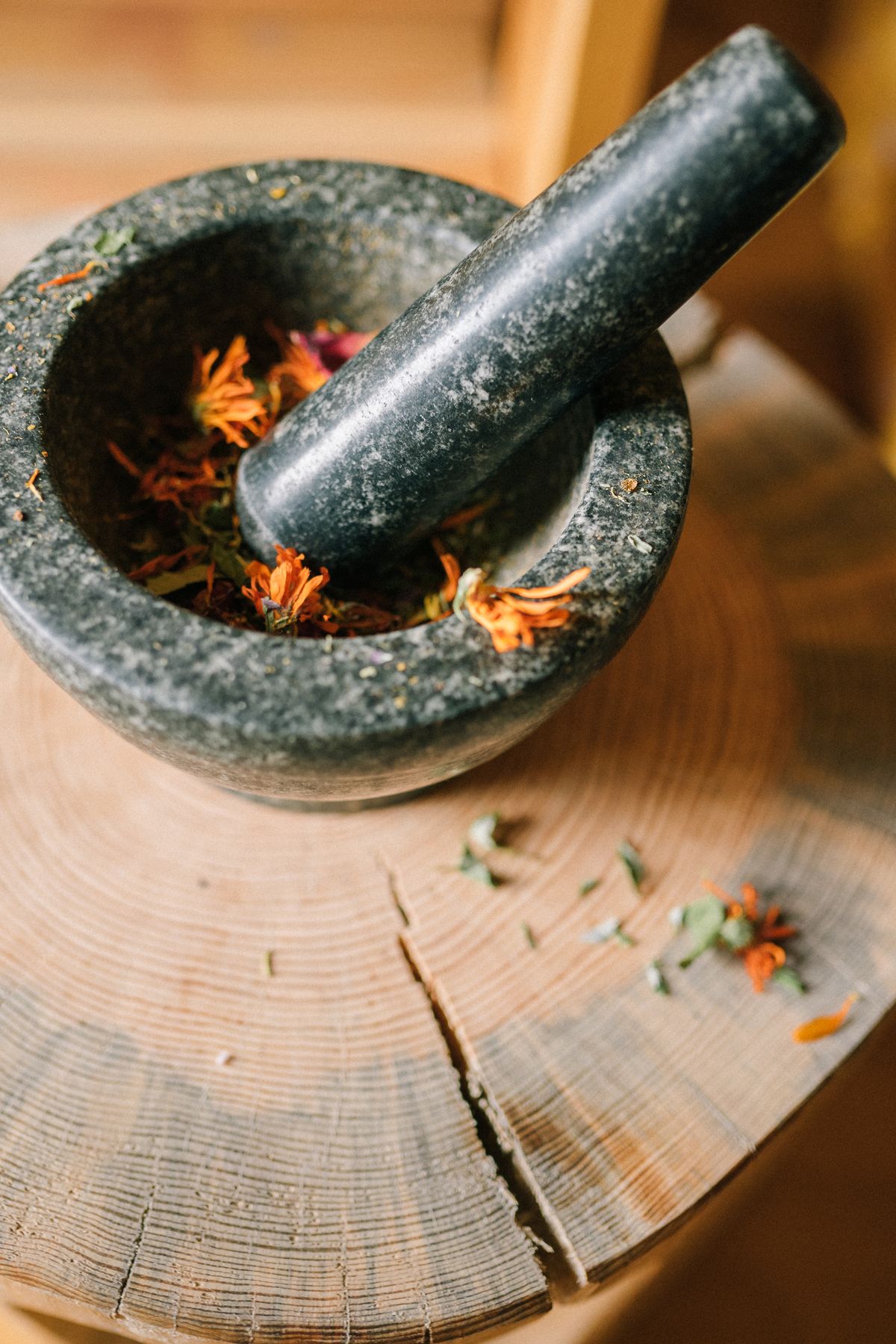 Mortar and pestle with fresh herbs on a wooden board, representing traditional Ayurvedic herbal preparation
The Traditional Methods of Prakriti Assessment
Nadi Pariksha (Pulse Diagnosis)
Nadi Pariksha is the most refined diagnostic tool in Ayurveda. First documented in the Sharangdhara Samhita of the 13th century and elaborated in the Yogaratnakara of the 17th century, this technique reads the pulse at the radial artery using three fingers:
- Index finger — reads Vata
- Middle finger — reads Pitta
- Ring finger — reads Kapha
A trained practitioner can detect not only which dosha dominates your constitution, but also the current state of each dosha in specific organs, the condition of the dhatus (tissues), and subtle emotional patterns held in the body. Pulse diagnosis operates at seven vertical levels of pressure, each revealing different layers of physiological and energetic information.
The reliability of nadi pariksha depends heavily on the practitioner's training and experience. A concordance study published in PubMed (2014) found 80% agreement between experienced Ayurvedic physicians and software-based assessment, with a kappa value of 0.77 — indicating substantial inter-rater reliability.
Ashtavidha Pariksha (Eightfold Examination)
Beyond pulse alone, classical Ayurveda employs an eightfold clinical examination:
- Nadi — Pulse
- Mutra — Urine
- Mala — Stool
- Jihva — Tongue
- Shabda — Voice and speech patterns
- Sparsha — Skin and touch
- Druk — Eyes
- Akriti — Overall body form and appearance
This comprehensive approach allows the practitioner to distinguish between what is innate (Prakriti) and what is acquired (Vikriti) — a distinction that questionnaires alone cannot reliably make.
How to Observe Your Own Constitution
While clinical assessment remains the gold standard, informed self-observation is a valuable complement. The key is to reflect on your lifelong tendencies — not your current state. Ask yourself: what was true of me as a child, before accumulated habits shaped my present condition?
Physical Indicators
| Feature | Vata | Pitta | Kapha |
|---|---|---|---|
| Frame | Slender, light, narrow | Medium, athletic | Broad, sturdy, well-built |
| Skin | Dry, rough, cool | Warm, sensitive, prone to redness | Smooth, oily, cool |
| Hair | Dry, thin, frizzy | Fine, prone to premature greying | Thick, lustrous, wavy |
| Eyes | Small, active, dark | Medium, sharp, light-coloured | Large, calm, deep |
| Digestion | Variable, irregular | Strong, intense | Slow, steady |
| Weight | Difficulty gaining | Gains and loses easily | Gains easily, hard to lose |
| Sleep | Light, interrupted | Moderate, sharp dreamer | Deep, heavy, prolonged |
Mental and Emotional Indicators
- Vata: Creative, quick-thinking, enthusiastic — but prone to anxiety, overwhelm, and scattered attention
- Pitta: Focused, ambitious, articulate — but prone to irritability, impatience, and perfectionism
- Kapha: Patient, loyal, steady — but prone to inertia, attachment, and resistance to change
Practical Guidelines for Self-Assessment
- Answer based on childhood and adolescence — before lifestyle habits accumulated
- Look at bone structure, not current weight — weight fluctuates with vikriti, but your skeletal frame reflects prakriti
- Consider what aggravates you most easily — the dosha that goes out of balance first is usually your dominant one
- Accept dual-dosha results — most people are not purely one dosha; a genuine split between two is the norm, not indecision
- Use quizzes as a starting point, not a conclusion — self-assessment captures tendencies, but pulse diagnosis provides confirmation
 Woman meditating in a peaceful setting, reflecting the self-awareness central to discovering your Prakriti
The Genomic Evidence for Prakriti
What makes Prakriti remarkable in the landscape of traditional medicine is that modern science has begun to validate its biological basis with increasing precision.
The landmark study was conducted at the CSIR-Centre for Cellular and Molecular Biology (CCMB) in Hyderabad. Researchers screened 3,416 healthy males aged 20–30 and selected 262 individuals with extreme single-dosha dominance. Using approximately one million genetic markers on an Affymetrix 6.0 SNP chip, the genomic data naturally clustered into three distinct groups — aligning with the Vata, Pitta, and Kapha classifications described in the Charaka Samhita thousands of years ago.
The study identified 52 SNPs that distinctly differentiate the three Prakriti types, published in Scientific Reports (Nature, 2015). Among the most notable findings:
- The gene PGM1, involved in carbohydrate metabolism, correlated directly with the metabolic phenotype described for Pitta in classical texts
- Kapha Prakriti types showed variants in the FTO and LEPR genes — the same genes associated with metabolic syndrome and obesity risk in modern genomics
- Pitta types showed overexpression of immune-response pathway genes and elevated haemoglobin levels
- Pharmacogenomic studies linked dosha types to polymorphisms in cytochrome P450 enzymes (CYP2C19, CYP2D6), which govern how individuals metabolise drugs — a direct bridge to personalised medicine
A machine learning study published in PLOS ONE (2017) further validated that Prakriti types form distinct, verifiable clusters within a multidimensional space of phenotypic traits, confirming that the classification is not arbitrary but rooted in measurable biology.
Where to Begin Your Prakriti Journey
Discovering your Prakriti is not a single moment — it is a process of deepening self-knowledge. Here is a practical path forward:
-
Start with self-observation — Use the physical and mental indicators above to form a preliminary understanding of your dominant dosha or dosha combination. Journal your observations over several weeks.
-
Take a structured questionnaire — Choose a validated tool such as the ones developed by the Central Council for Research in Ayurvedic Sciences (CCRAS) or established Ayurvedic institutions. Answer based on lifelong tendencies, not current symptoms.
-
Seek a clinical assessment — Work with a qualified Ayurvedic practitioner who can perform pulse diagnosis and distinguish your Prakriti from your Vikriti with clinical precision.
-
Apply what you learn gradually — Begin aligning your diet, daily routine, and seasonal habits with your constitutional type. Notice how your body responds when you eat, sleep, and move in harmony with your nature.
-
Revisit and refine — As your understanding deepens, the distinction between your innate constitution and acquired patterns becomes clearer. Ayurveda is a lifelong practice of attunement.
Your Prakriti is not a label — it is a language for understanding the patterns that have shaped your body and mind since before you were born. When you learn to read those patterns, you gain the most personalised health framework in existence: one written in your own biology.
Sources & Further Reading
Research
- Prasher, B. et al. (2015). Genome-wide analysis correlates Ayurveda Prakriti. Scientific Reports (Nature). View on Nature
- Tiwari, S. et al. (2017). Recapitulation of Ayurveda constitution types by machine learning of phenotypic traits. PLOS ONE. View on PMC
- Ghodke, Y. et al. (2011). Traditional Medicine to Modern Pharmacogenomics: Ayurveda Prakriti Type and CYP2C19 Gene Polymorphism. Evidence-Based Complementary and Alternative Medicine. View on PubMed
- Joshi, K. et al. (2025). Prakriti (constitutional typology) in Ayurveda: a critical review of Prakriti assessment tools and their scientific validity. Frontiers in Medicine. View on Frontiers
- Dey, S. & Pahwa, P. (2014). Determinants of prakriti, the human constitution types of Indian traditional medicine and its correlation with contemporary science. Journal of Ayurveda and Integrative Medicine. View on PubMed
Further Reading
- Prakriti Assessment in Ayurveda — Frontiers in Medicine
- Ayurgenomics: Bringing Age-Old Wisdom to Healthcare — CSIR
- Dosha Quiz — Banyan Botanicals
Image Credits
- Cover: Healthy herbs and drink on a wooden tray — Pexels
- Mortar and pestle with herbs — Pexels
- Woman doing meditation — Pexels
All images free to use under the Pexels License.