
Meditation is not a modern wellness trend — it is one of the oldest therapeutic tools in the Ayurvedic pharmacopoeia. The Charaka Samhita, compiled over two thousand years ago, prescribes Dhyana (meditation) as essential for preserving mental health, preventing psychiatric disorders, and cultivating the deep self-awareness that Ayurveda considers the foundation of all healing. But unlike one-size-fits-all meditation apps, Ayurveda recognises that each person's mind is different — shaped by the same constitutional forces that govern the body. Your dosha determines not just how you eat and sleep, but how you should meditate.
Dhyana: The Ayurvedic Science of Meditation
In the Ayurvedic and Yogic traditions, meditation is not simply "sitting quietly." Dhyana — from the Sanskrit root dhyai, meaning to contemplate or meditate — refers to a specific state of sustained, absorbed awareness. The Charaka Samhita describes it as one of the most important therapies for Manas Roga (disorders of the mind), alongside Sadvritta (ethical conduct), Achara Rasayana (behavioural rejuvenation), and appropriate use of herbs and diet.
The ancient texts place Dhyana within the broader framework of Ashtanga Yoga (Patanjali's eight-limbed path), where it occupies the seventh limb — preceded by Pratyahara (sense withdrawal) and Dharana (concentration), and followed by Samadhi (complete absorption). In Ayurveda, this sequence is not merely philosophical. It reflects a practical understanding of how the mind settles: the senses must first be withdrawn from external stimulation, attention must then be focused on a single point, and only from that focused state can true meditation emerge.
Crucially, Ayurveda teaches that the techniques used to achieve this settling must be matched to the individual's Prakriti (inherent constitution) and Vikriti (current imbalance). A practice that grounds an anxious Vata mind may bore a sluggish Kapha mind into sleep. A technique that energises Kapha may inflame Pitta's already intense focus. This is the principle of personalised meditation — and it is as central to Ayurveda as personalised diet or herbal prescription.
Meditation for Vata: Grounding the Restless Mind
Vata dosha — governed by the elements of air and ether — produces a mind that is quick, creative, and expansive, but easily scattered. When Vata is aggravated, the mind becomes anxious, restless, and unable to settle. Thoughts race. The body fidgets. Sleep eludes. This is the person who sits down to meditate and immediately begins planning tomorrow's schedule.
Ayurveda recommends meditation practices with qualities opposite to Vata: slow, warm, steady, grounding, and rhythmic.
Recommended Practices for Vata
- Nadi Shodhana (Alternate Nostril Breathing) as a preparatory practice. A systematic review of 44 randomised controlled trials found that alternate nostril breathing provides high-level evidence for positive outcomes on the autonomic nervous system, reducing pulse rate, respiratory rate, and blood pressure while activating the vagus nerve and enhancing parasympathetic dominance — precisely the physiological shift that calms Vata.
- Body scan meditation, moving awareness slowly and systematically from the feet upward, anchoring the mind in physical sensation.
- Slow mantra repetition — traditionally Om or Ram — using Japa Mala (meditation beads) to provide tactile grounding and rhythmic structure.
- Guided visualisation of warm, stable imagery: a golden flame, a mountain, roots extending into the earth.
The ideal time for Vata types to meditate is during the Kapha period (6–10 AM), when the natural heaviness and stability of Kapha counterbalances Vata's inherent lightness and mobility.
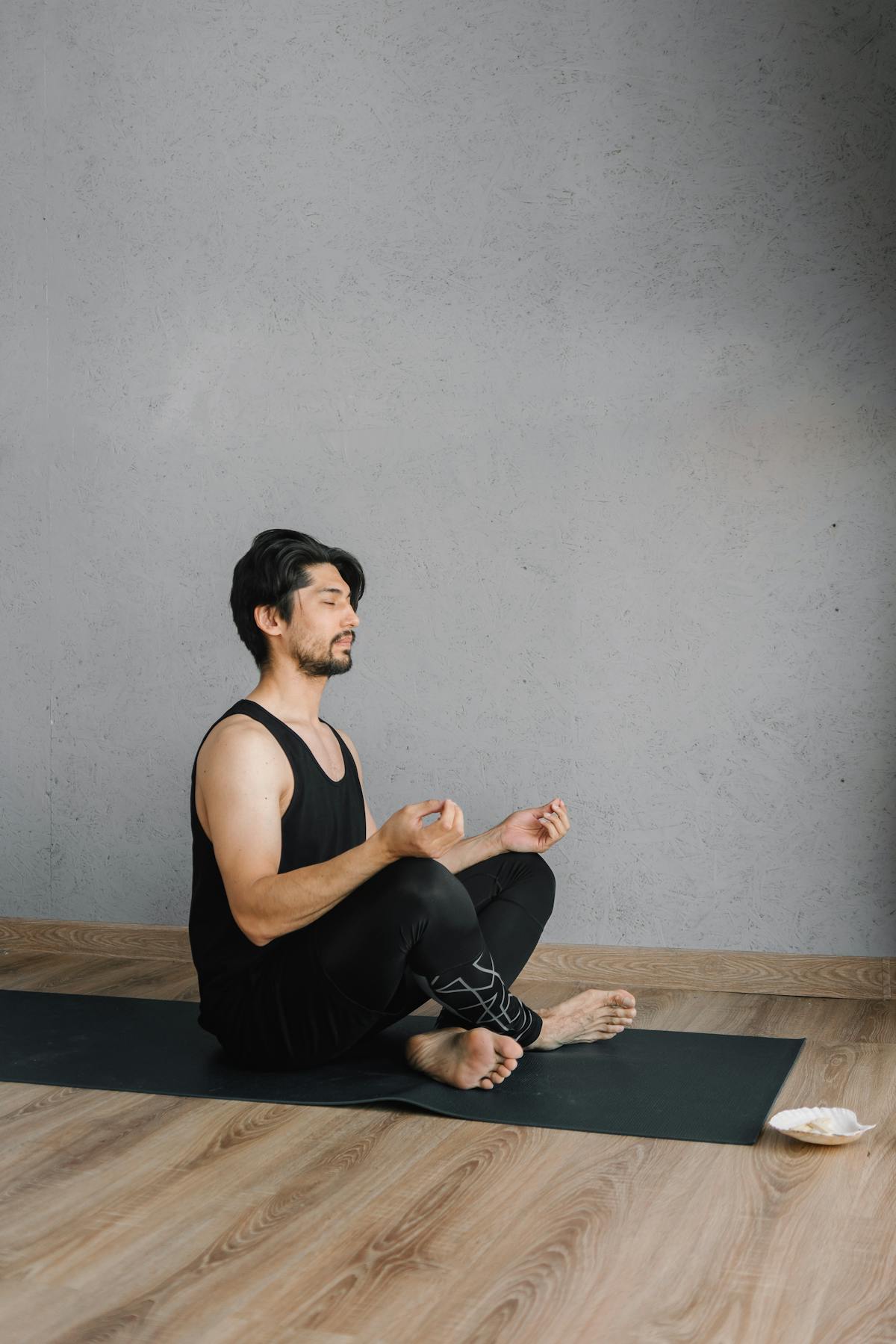 Man in black activewear sitting cross-legged in meditation on a yoga mat, demonstrating the grounded, steady posture recommended for Vata-balancing meditation
Meditation for Pitta: Cooling the Intense Mind
Pitta dosha — governed by fire and water — produces a mind that is sharp, focused, and determined, but prone to intensity. When Pitta is aggravated, meditation itself can become a competitive project. The Pitta mind approaches practice with the same driven quality it brings to everything else: "I will master this. I will be the best meditator." This intensity defeats the purpose.
Ayurveda recommends meditation practices with cooling, softening, and surrendering qualities.
Recommended Practices for Pitta
- Metta (Loving-Kindness) Meditation, systematically generating feelings of compassion toward oneself, loved ones, neutral people, and even those who trigger frustration. This directly counteracts Pitta's tendency toward judgement and irritability.
- Sitali Pranayama (Cooling Breath) as preparation — inhaling through a curled tongue, exhaling through the nose. This technique directly reduces physiological heat and has been shown to lower sympathetic nervous system activation.
- Nature visualisation — cool moonlight, still lakes, waterfalls, snow-capped mountains — engaging the mind's imagery centres with cooling sensory input.
- Non-directive meditation, where the practitioner releases all effort, goals, and technique, simply allowing thoughts to arise and pass. This is profoundly challenging for Pitta — and profoundly balancing.
Pitta types should avoid meditating during the Pitta peak (10 AM–2 PM) in warm weather. The late afternoon Vata period (2–6 PM) or early evening provides a cooler, more settling context.
Meditation for Kapha: Awakening the Heavy Mind
Kapha dosha — governed by earth and water — produces a mind that is calm, loyal, and steady, but prone to inertia. When Kapha is aggravated, the mind becomes heavy, foggy, and resistant to change. The Kapha mind does not race — it sinks. This is the person who sits to meditate and falls asleep within five minutes.
Ayurveda recommends meditation practices with stimulating, lightening, and upward-moving qualities.
Recommended Practices for Kapha
- Kapalabhati (Skull-Shining Breath) and Bhastrika (Bellows Breath) as preparatory pranayama. These vigorous techniques generate internal heat, clear respiratory congestion, and stimulate metabolic fire (Agni), counteracting Kapha's cold, damp qualities.
- Walking meditation or dynamic meditation, incorporating gentle movement to prevent stagnation.
- Stimulating mantra chanting — particularly rhythmic, energising mantras chanted aloud rather than silently — engages Kapha's need for auditory and vibratory stimulation.
- Visualisation of upward-moving energy — light rising through the body, fire, sunrise, upward-spiralling breath — counteracting Kapha's downward, earthward tendency.
The ideal meditation time for Kapha types is early morning before the Kapha period begins — the pre-dawn Brahma Muhurta (approximately 4:30–6:00 AM), when Sattva guna is predominant and the mind is naturally clear.
| Dosha | Core Challenge | Preparatory Pranayama | Meditation Style | Best Time |
|---|---|---|---|---|
| Vata | Restlessness, anxiety, scattered attention | Nadi Shodhana (Alternate Nostril) | Body scan, slow mantra Japa, grounding visualisation | 6–10 AM (Kapha period) |
| Pitta | Intensity, perfectionism, irritability | Sitali (Cooling Breath) | Metta (Loving-Kindness), nature visualisation, non-directive | 2–6 PM (Vata period) |
| Kapha | Heaviness, drowsiness, mental fog | Kapalabhati, Bhastrika | Walking meditation, dynamic chanting, upward visualisation | 4:30–6 AM (Brahma Muhurta) |
What Modern Science Reveals
The Ayurvedic understanding that meditation affects not just mood but the fundamental physiology of the body is now supported by a substantial body of clinical evidence.
Neuroplasticity and brain structure. A 2024 systematic review published in PMC synthesised the neurobiological changes induced by mindfulness and meditation, finding that regular practice enhances brain regions related to emotional processing and sensory perception, increases grey matter density in the prefrontal cortex and hippocampus, reduces amygdala reactivity, and improves brain connectivity. Vipassana meditators showed significantly higher degree connectivity in the right hippocampus compared to non-meditators — a finding with implications for memory preservation and Alzheimer's prevention.
Cortisol reduction. A meta-analysis published in Health Psychology Review tested meditation's effect on cortisol in at-risk populations. Based on 10 studies using blood samples, meditation interventions demonstrated a significant, medium effect on cortisol reduction compared to control groups. Notably, the analysis found that different forms of meditation impact cortisol to differing degrees — autonomic self-transcending forms showed less effect than focused-attention practices — supporting the Ayurvedic principle that technique selection matters.
The BDNF–cortisol–hippocampus pathway. A landmark randomised clinical trial with 332 healthy adults found that nine months of contemplative mental training increased serum BDNF (brain-derived neurotrophic factor), decreased cortisol secretion, and increased dentate gyrus volume in the hippocampus. This provides a direct mechanistic link: meditation reduces stress hormones, which upregulates neurotrophic factors, which promotes growth in the brain region most critical for memory and emotional regulation.
Autonomic nervous system modulation. A systematic review of 44 randomised controlled trials on alternate nostril breathing found high-level evidence for positive outcomes on the autonomic and cardiopulmonary systems, including reductions in systolic and diastolic blood pressure, heart rate, and respiratory rate, with enhanced parasympathetic tone through vagal activation.
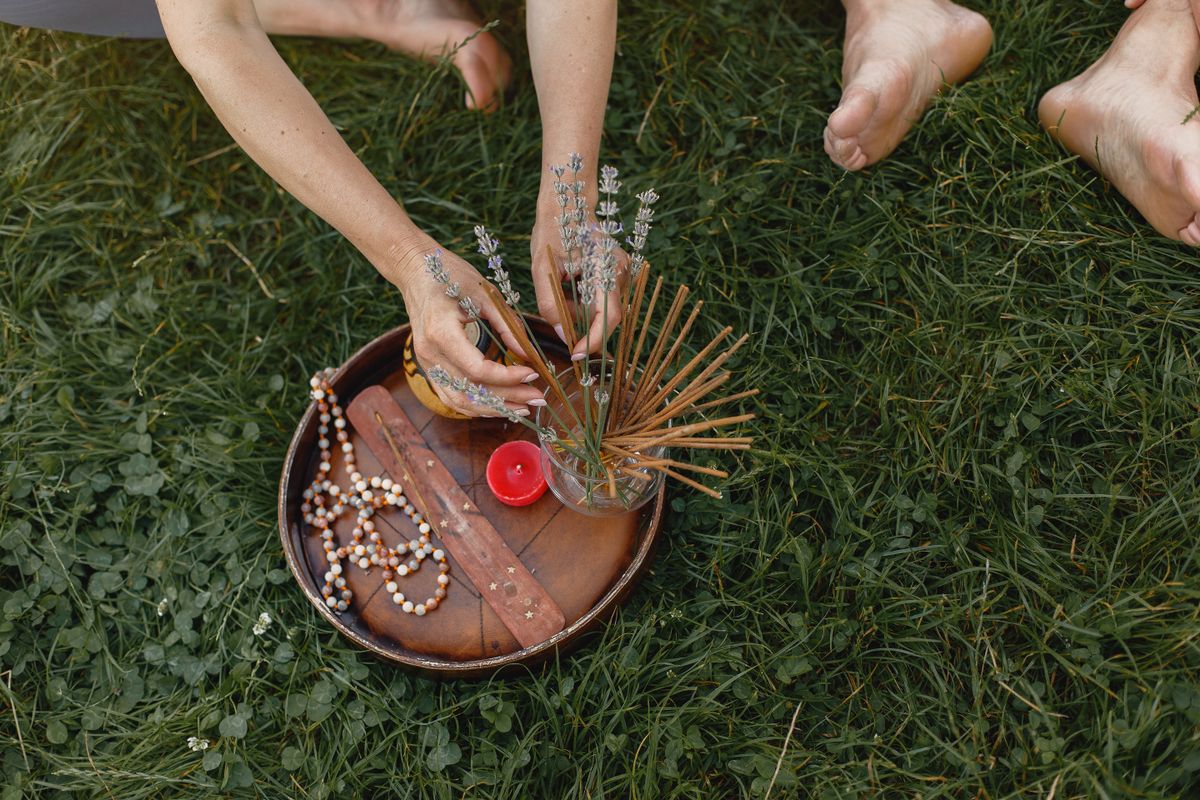 Incense sticks and flowers creating a calm meditative atmosphere, reflecting the Ayurvedic use of sensory environment to support meditation practice
Building Your Personalised Practice
Integrating Ayurvedic principles into your meditation does not require dramatic changes. It means applying the same logic of individualisation that Ayurveda brings to diet, herbs, and daily routine.
Assess your constitution. Know your Prakriti (inherent dosha balance) and your Vikriti (current imbalance). Your meditation practice should address your Vikriti — the imbalance you are experiencing now — rather than defaulting to a single technique for life.
Prepare the body before the mind. Ayurveda recommends a sequence: gentle movement or yoga to release physical tension, pranayama matched to your dosha to calm the nervous system, and only then sitting for meditation. This mirrors the classical Ashtanga sequence and reflects the practical reality that a body in discomfort cannot sustain mental stillness.
Create a supportive sensory environment. Ayurveda recognises that the senses (Indriyas) directly influence the mind. A Vata-pacifying meditation space might include warm lighting, a heavy blanket, and grounding aromas like sandalwood or vetiver. A Pitta-pacifying space benefits from cool colours, minimal stimulation, and sweet aromas like rose or jasmine. A Kapha-pacifying environment needs brightness, upward-facing windows, and stimulating aromas like eucalyptus or camphor.
Be consistent, not ambitious. The Charaka Samhita emphasises Nitya (regularity) over Adhika (excess). Ten minutes of daily meditation produces more benefit than an hour once a week. Build the habit first; depth follows naturally.
The ancient Ayurvedic practitioners understood that the mind is not separate from the body, and that the same constitutional forces that determine your physical tendencies — your digestion, your sleep patterns, your vulnerability to specific diseases — also determine the landscape of your inner world. By matching meditation practice to dosha, Ayurveda transforms meditation from a generic exercise into a precise, personalised therapeutic tool — one that modern neuroscience is now confirming works at the deepest levels of brain structure and hormonal regulation.
Sources & Further Reading
Research
- Neurobiological Changes Induced by Mindfulness and Meditation: A Systematic Review. (2024). PMC. View on PMC
- Tuladhar, R. et al. (2024). Serum BDNF Increase After 9-Month Contemplative Mental Training Is Associated With Decreased Cortisol Secretion and Increased Dentate Gyrus Volume. Frontiers in Human Neuroscience. View on PMC
- Meditation interventions efficiently reduce cortisol levels of at-risk samples: a meta-analysis. (2020). Health Psychology Review. View on Taylor & Francis
- Alternate nostril breathing: a systematic review of clinical trials. (2017). International Journal of Research in Medical Sciences. View on MSJONLINE
- Assessment of the Effects of Pranayama/Alternate Nostril Breathing on the Parasympathetic Nervous System in Young Adults. (2013). PMC. View on PMC
- Nadi Shodhan Pranayama as an Adjunct in Hypertensives: An Exploratory Randomised Trial. (2025). PMC. View on PMC
- Mindfulness Meditation Is Related to Long-Lasting Changes in Hippocampal Functional Topology during Resting State. (2018). Neural Plasticity. View on PMC
Further Reading
- Meditation for Your Dosha — Art of Living Retreat Center
- How to Choose a Meditation Practice for Your Dosha — Kripalu
- Breathe Better with Pranayama: Dosha-Specific Techniques — Uma Wellness
- Dhyana in the Charaka Samhita — CarakaSamhitaOnline
Image Credits
- Cover: Woman sitting on a rock near the sea while meditating — Pexels
- Man in black activewear doing meditation on a yoga mat — Pexels
- Incense sticks and flowers on a glass cup — Pexels
All images free to use under the Pexels License.