
Ayurveda is not merely a system of medicine — it is a complete philosophy of life. Rooted in the ancient soils of India, this 5,000-year-old tradition offers a profound framework for understanding who you are, why you feel the way you feel, and how to live in alignment with nature. For those seeking a path beyond symptom management, Ayurveda offers something rare: the science of thriving.
The Origins of Ayurveda
Ayurveda's foundations are found in the Vedas, the oldest scriptures of human civilization. Its primary texts — the Charaka Samhita (focused on internal medicine) and the Sushruta Samhita (focused on surgery) — were compiled between 600 BCE and 600 CE, but their oral traditions stretch back thousands of years earlier.
The World Health Organization (WHO) recognizes Ayurveda as a traditional medicine system and has worked with India to integrate it into national health policy. Today, an estimated 80% of India's population uses Ayurvedic medicine in some form, and its influence has spread to over 40 countries worldwide.
The Core Philosophy: You Are Nature
Ayurveda begins with a fundamental premise: human beings are not separate from nature — we are nature. The same five elements that compose the cosmos — earth (prithvi), water (jala), fire (agni), air (vayu), and ether (akasha) — compose our bodies.
Health, in Ayurveda, is not the absence of disease. It is a state of perfect balance between body, mind, and spirit — what the Charaka Samhita defines as swastha: "one who is established in the self."
This philosophy has a direct practical implication: imbalance in any one domain creates imbalance in all. Chronic stress, poor sleep, processed food, and emotional suppression are not separate problems — they are expressions of the same underlying disharmony.
The Three Doshas: Your Unique Blueprint
At the heart of Ayurvedic theory are the three doshas — bioenergetic forces that govern every function in the body and mind.
| Dosha | Elements | Qualities | Governs |
|---|---|---|---|
| Vata | Air + Ether | Dry, light, mobile, cold | Movement, creativity, nervous system |
| Pitta | Fire + Water | Hot, sharp, oily, intense | Digestion, metabolism, intelligence |
| Kapha | Earth + Water | Heavy, slow, stable, cold | Structure, immunity, emotional groundedness |
Every person is born with a unique combination of these three doshas — called their prakriti (constitution). Most people have one or two dominant doshas. Understanding your prakriti is the starting point of all Ayurvedic practice, because what is healthy for one person may be imbalancing for another.
When a dosha accumulates beyond your natural ratio, it creates vikriti (imbalance). This imbalance, if left unaddressed, progresses through six stages — from subtle energetic disturbance all the way to structural disease.
 Ayurvedic practitioner preparing herbal remedies
Agni: The Central Pillar of Health
In Ayurveda, agni — the digestive fire — is considered the single most important factor in health. A 2020 review published in Frontiers in Pharmacology noted that Ayurvedic concepts of digestive function map closely onto modern understanding of the gut microbiome, intestinal permeability, and systemic inflammation.
A strong agni means food is fully transformed into nourishing tissue. When agni weakens, ama (undigested metabolic waste) accumulates — the Ayurvedic root cause of most chronic disease. Supporting agni through food choices, meal timing, and herbal support is therefore central to all Ayurvedic protocols.
Ayurveda's Eight Branches
Classical Ayurveda is structured into eight clinical specialties — Ashtanga Ayurveda:
- Kayachikitsa — Internal medicine
- Balachikitsa — Pediatrics
- Graha Chikitsa — Psychiatry and mental health
- Urdhvanga Chikitsa — ENT and ophthalmology
- Shalya Tantra — Surgery
- Damstra Chikitsa — Toxicology
- Jara Chikitsa — Rejuvenation and anti-aging (rasayana)
- Vrsha Chikitsa — Reproductive medicine and aphrodisiacs
This breadth reveals that Ayurveda was never a fringe folk tradition — it was a complete medical system sophisticated enough to perform surgical procedures and classify psychiatric disorders millennia before Western medicine did the same.
The Modern Scientific Case for Ayurveda
The last two decades have seen a surge in rigorous scientific investigation of Ayurvedic compounds:
- Ashwagandha (Withania somnifera): A 2019 randomized controlled trial in Medicine found that ashwagandha root extract significantly reduced stress and anxiety scores and lowered serum cortisol levels compared to placebo.
- Turmeric/Curcumin: Over 3,000 peer-reviewed studies have investigated curcumin's anti-inflammatory, antioxidant, and neuroprotective properties.
- Triphala: A 2017 review in the Journal of Alternative and Complementary Medicine confirmed its efficacy as a digestive tonic and mild laxative, with antioxidant properties comparable to vitamin C.
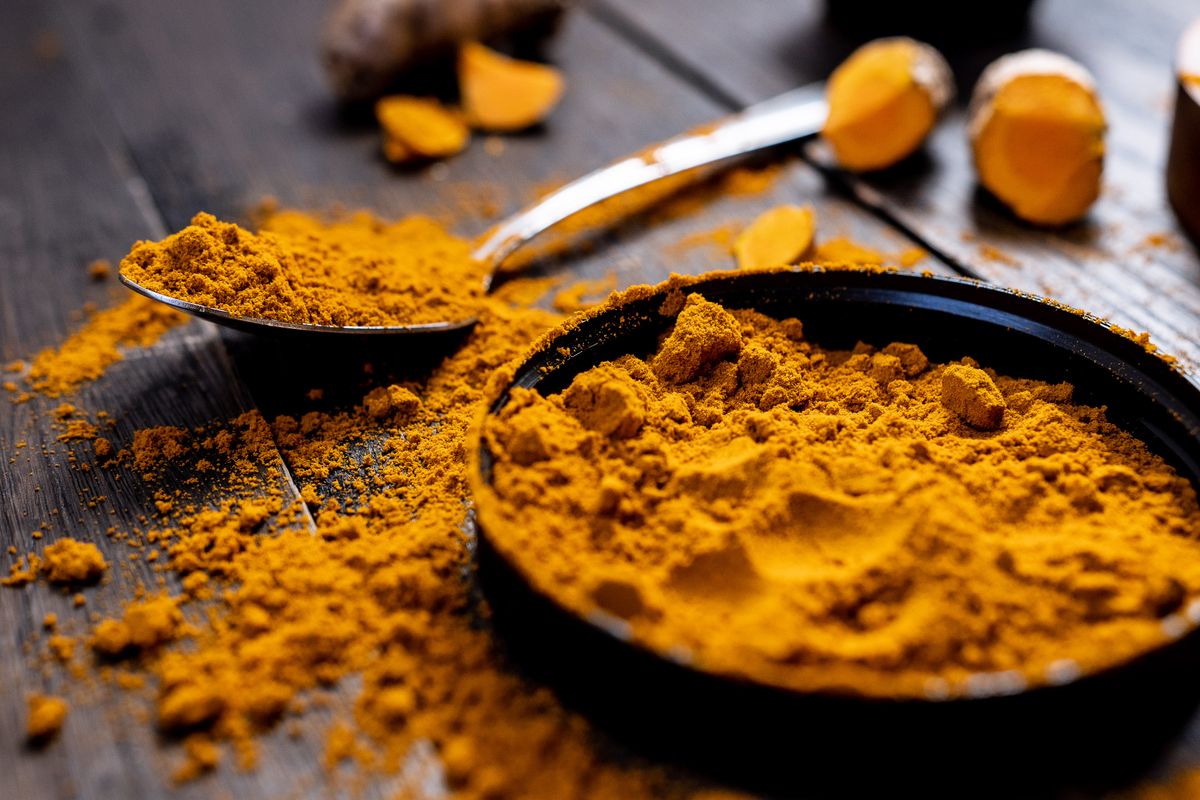 Close-up of golden turmeric powder
Where to Begin
The beauty of Ayurveda is that it meets you where you are. You do not need to overhaul your life overnight. Begin with these foundational steps:
- Discover your dosha — Work with a practitioner to assess your prakriti through pulse diagnosis and constitutional questionnaires.
- Establish a morning routine (dinacharya) — Wake before sunrise, scrape your tongue, drink warm water, and move your body.
- Eat for your constitution — Favour foods that balance your dominant dosha.
- Support your agni — Eat your largest meal at midday, avoid cold drinks with food, and include digestive spices like ginger, cumin, and fennel.
Ayurveda is not a quick fix. It is a lifelong practice of attuning to your own nature — and in doing so, finding your way back to genuine health.
Sources & Further Reading
Research
- Chandrasekhar, K. et al. (2019). A Prospective, Randomized Double-Blind, Placebo-Controlled Study of Safety and Efficacy of a High-Concentration Full-Spectrum Extract of Ashwagandha Root. Medicine. View on PubMed
- Baliga, M.S. et al. (2017). Triphala, Ayurvedic Formulation for Treating and Preventing Cancer. Journal of Alternative and Complementary Medicine. View on PubMed
- Mukherjee, P.K. et al. (2020). Ayurveda and the science of ageing. Journal of Ethnopharmacology. View on ScienceDirect
Further Reading
- Ayurveda: Ancient Wisdom for Modern Times — Harvard Health
- WHO Traditional Medicine Strategy 2019–2025
Image Credits
- Cover: Ayurvedic herbs and spices — Pexels
- Practitioner preparing remedies — Pexels
- Turmeric root and powder — Pexels
All images free to use under the Pexels License.