
Yoga and Ayurveda are not separate disciplines that happen to share a cultural origin — they are two halves of a single Vedic system designed to work together. Yoga provides the practices — asana, pranayama, meditation — that transform body and mind. Ayurveda provides the science of individual constitution, the diagnostic framework, and the dietary and herbal protocols that make those practices effective for each unique person. The ancient rishis who codified both sciences understood that without Ayurveda, yoga lacks individualisation; without yoga, Ayurveda lacks its most powerful tools for self-transformation. Modern clinical research is now confirming what these sages knew millennia ago — and the evidence for their combined power is striking.
Two Roots, One Tree: The Vedic Origins
Both Yoga and Ayurveda emerge from the Vedas, the oldest recorded body of knowledge in the Indian tradition, dating back over 5,000 years. Yoga arises primarily from the Yajur Veda, while Ayurveda draws from the Atharva Veda and Rig Veda. Together with Jyotish (Vedic astrology), they form the three great sister sciences of the Vedic system — each addressing a different dimension of human existence.
Their philosophical bedrock is shared: both rest upon Samkhya philosophy, which describes reality through the interplay of Purusha (pure consciousness) and Prakriti (nature, matter). From Prakriti emerge the three Gunas — Sattva (harmony), Rajas (activity), and Tamas (inertia) — and the five elements (Panchamahabhutas): earth, water, fire, air, and ether. These elements combine to form the three doshas — Vata, Pitta, and Kapha — which are central to both Ayurvedic diagnosis and yogic practice.
The Charaka Samhita, one of Ayurveda's foundational texts, explicitly references yoga — particularly Raja Yoga — as a path to liberation from suffering, and prescribes yogic practices including the Yamas and Niyamas (ethical disciplines) as essential to both physical health and spiritual growth. King Bhoja, in the 11th century, captured the unity of these traditions in a famous prayer: "I bow to Patanjali, who removed the impurities of the mind through yoga, the impurities of speech through grammar, and the impurities of the body through medicine."
| Discipline | Primary Veda | Domain | Goal |
|---|---|---|---|
| Yoga | Yajur Veda | Mind, consciousness, spiritual practice | Self-realisation (Moksha) |
| Ayurveda | Atharva Veda / Rig Veda | Body, health, individualised healing | Longevity and freedom from disease |
| Jyotish | Rig Veda | Time, cosmic rhythms, karma | Alignment with natural and cosmic cycles |
How Ayurveda Personalises Yoga
The defining contribution of Ayurveda to yoga practice is individualisation. In a typical modern yoga class, every student performs the same sequence at the same intensity — regardless of body type, mental state, or seasonal conditions. Ayurveda considers this a fundamental error. What heals one constitution can aggravate another.
Ayurveda assesses each person through two lenses: Prakriti (inherent constitution, determined at conception) and Vikriti (current state of imbalance). This dual assessment determines which yoga practices will restore balance — and which will deepen dysfunction.
Vata (Air + Ether) — The Need for Grounding
When Vata is aggravated — presenting as anxiety, restlessness, insomnia, cold extremities, and scattered thinking — yoga should be slow, steady, warming, and grounding. Recommended practices include longer-held standing poses like Virabhadrasana (Warrior) and Vrikshasana (Tree Pose), forward folds such as Paschimottanasana, and generous time in Savasana. Vinyasa sequences should be slow and rhythmic, never rushed. The ideal pranayama is Nadi Shodhana (alternate nostril breathing), which calms the nervous system and restores Vata's need for regularity.
Pitta (Fire + Water) — The Need for Cooling
When Pitta is aggravated — manifesting as irritability, inflammation, overheating, competitiveness, and skin conditions — yoga should be cooling, non-competitive, and surrendering. Moon salutations replace sun salutations; twists, gentle backbends, and restorative poses take precedence over power sequences. The key is releasing the drive to achieve. Sitali Pranayama (cooling breath, inhaling through a curled tongue) directly reduces Pitta's heat, and Yoga Nidra offers deep restoration without effort.
Kapha (Earth + Water) — The Need for Stimulation
When Kapha is aggravated — showing as heaviness, lethargy, congestion, weight gain, and emotional stagnation — yoga should be vigorous, warming, and dynamic. Ashtanga, dynamic Vinyasa, and strong backbends counteract Kapha's inherent inertia. Multiple rounds of Surya Namaskar (Sun Salutations) generate internal heat. Kapalabhati (skull-shining breath) stimulates metabolism and clears congestion from the respiratory channels.
 Woman meditating on a yellow mat outdoors in a peaceful natural setting, demonstrating the meditative dimension of yoga that Ayurveda integrates with personalised health practices
Pranayama: Where Yoga and Ayurveda Meet Most Precisely
Pranayama — the yogic science of breath control — is the practice where Yoga and Ayurveda converge most directly. In Ayurveda, Prana is the vital life force that sustains all physiological and psychological functions. The breath is Prana's primary vehicle, and how you breathe directly influences your dosha balance, nervous system regulation, and mental clarity.
A 2025 systematic review and meta-analysis published in Frontiers in Psychiatry found that pranayama as a standalone intervention significantly reduced symptoms of anxiety and depression across multiple randomised controlled trials. The review noted that pranayama's effects include modulation of autonomic nervous system function, reduction of cortisol secretion, and enhancement of parasympathetic tone — mechanisms that Ayurveda has described for millennia through the lens of Prana, Vata, and the subtle body channels (Nadis).
| Dosha Imbalance | Recommended Pranayama | Effect | Modern Mechanism |
|---|---|---|---|
| Vata (anxiety, insomnia) | Nadi Shodhana (Alternate Nostril) | Grounding, calming, balancing | Autonomic balance, vagal tone increase |
| Pitta (irritability, heat) | Sitali (Cooling Breath), Chandra Bhedana | Cooling, soothing, surrendering | Sympathetic downregulation, cortisol reduction |
| Kapha (lethargy, congestion) | Kapalabhati (Skull-Shining), Bhastrika | Stimulating, clearing, energising | Metabolic activation, increased O₂ exchange |
What Modern Science Reveals
The clinical evidence for yoga's health benefits — and for the integrated yoga-Ayurveda approach — has expanded dramatically in recent years. Several landmark findings stand out:
Yoga as the most effective exercise for cortisol reduction. A 2025 network meta-analysis published in MDPI Sports, analysing 44 randomised controlled trials, found that yoga demonstrated the greatest effect of any exercise modality for reducing cortisol in adults with psychological distress (SMD = −0.59; 95% CI −0.90 to −0.28; SUCRA = 93%). Yoga outperformed qigong, aerobic exercise, resistance training, and multicomponent programmes.
Significant stress reduction. A 2024 meta-analysis in Frontiers in Psychiatry, encompassing 13 RCTs with 1,026 participants, found a moderate-to-large short-term effect on perceived stress (SMD = −0.69, 95% CI −1.12 to −0.25). The documented mechanisms include HPA axis downregulation, parasympathetic nervous system activation, and modulation of brain-derived neurotrophic factor (BDNF).
Integrated yoga-Ayurveda clinical outcomes. Research published in the Journal of Ayurveda and Integrative Medicine has shown benefits of combined yoga-Ayurveda interventions for chronic lower back pain, Type 2 diabetes glycaemic control, and post-COVID rehabilitation. A 2024 randomised controlled trial found that yoga combined with Ayurvedic Kati Basti therapy produced significantly greater improvements in chronic lower back pain than either intervention alone.
Pranayama mechanisms validated. A 2024 systematic review of 89 studies (including 17 RCTs) published in the Indian Journal of Integrative Medicine identified the molecular, biochemical, and pathophysiological mechanisms through which yoga and pranayama produce benefits across neuropsychological, cardiovascular, respiratory, gastrointestinal, and endocrine disorders — providing a scientific framework for effects Ayurveda has observed clinically for millennia.
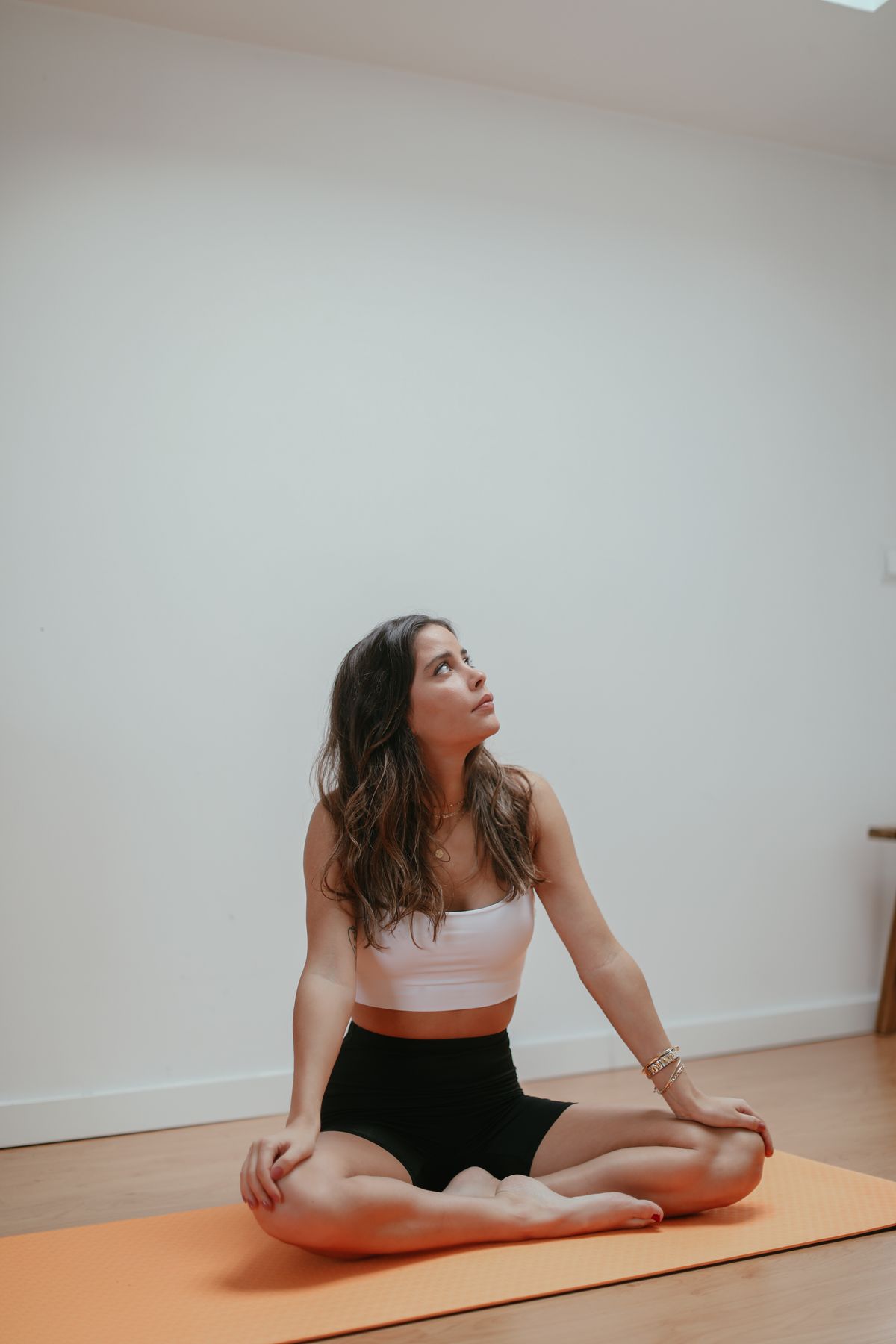 Woman seated on a yoga mat in a mindful, meditative posture, reflecting the Ayurvedic principle of matching practice to individual constitution
Practising Together: A Framework for Integration
Integrating Ayurveda into your yoga practice does not require abandoning your current routine. It means adding a layer of self-awareness and individualisation that deepens every aspect of practice:
Know Your Constitution
Begin with an honest assessment of your Prakriti (natural constitution) and Vikriti (current imbalances). A qualified Ayurvedic practitioner can provide a formal assessment; validated self-assessment tools also exist in the clinical literature. This knowledge becomes the compass for every practice decision.
Align with the Ayurvedic Clock
The Dosha Kala (Ayurvedic clock) identifies optimal practice times. The Kapha window (6–10 AM) offers natural stability and physical strength — ideal for most yoga practice. The Vata period (2–6 AM and 2–6 PM) supports meditation and subtle practices. Avoid vigorous practice during the Pitta peak (10 AM–2 PM) in summer, when the body's internal heat is already high.
Adapt Seasonally
Ayurveda's Rutucharya (seasonal regimen) adjusts practice throughout the year. In winter, when Kapha accumulates and Agni is strong, practise more vigorously. In summer, when Pitta rises, shift toward cooling, less intense sequences. During the monsoon or humid months, when Vata is easily disturbed, emphasise grounding, warming, and stabilising practices.
Support Practice with Ayurvedic Nutrition and Herbs
Yoga practice is enhanced by Ayurvedic dietary and herbal support. Ashwagandha (Withania somnifera) supports recovery, reduces exercise-induced cortisol, and promotes restful sleep — a meta-analysis of five RCTs found it significantly improved sleep quality (SMD −0.59). Brahmi (Bacopa monnieri) enhances mental clarity during meditation. Trikatu kindles digestive fire before meals, ensuring the nutrients that fuel practice are properly absorbed.
The Complete Path
The ancient rishis did not separate the health of the body from the health of the mind, or either from the journey toward self-realisation. They understood that a body burdened by disease cannot sit in meditation, that a mind clouded by stress cannot perceive truth, and that spiritual practice without physical health is built on unstable ground. This is why they created two sciences — one for healing, one for transformation — and designed them to function as one.
Modern research is now validating this integrated vision with the tools of clinical science: cortisol measurements, brain imaging, autonomic function studies, and randomised controlled trials. The evidence consistently shows that yoga and Ayurveda are more effective together than apart — the personalisation that Ayurveda provides amplifies the benefits that yoga delivers. In an era when wellness is often reduced to generic routines and one-size-fits-all programmes, the oldest individualised health system in the world offers something deeper: a practice designed specifically for you, guided by a science that has been refining its understanding of the human body for over five thousand years.
Sources & Further Reading
Research
- Schleinzer, L. et al. (2024). Effects of Yoga on Stress in Stressed Adults: A Systematic Review and Meta-Analysis. Frontiers in Psychiatry. View on PMC
- Optimal Exercise Modality and Dose for Cortisol Reduction in Psychological Distress: A Systematic Review and Network Meta-Analysis. (2025). MDPI Sports. View on PMC
- Mütze, K. et al. (2025). Effectiveness of Pranayama for Mental Disorders: A Systematic Review and Meta-Analysis of Randomized Controlled Trials. Frontiers in Psychiatry. View on PMC
- Varne, A. & Balaji, P. (2024). A Systematic Review on Molecular, Bio-Chemical, and Pathophysiological Mechanisms of Yoga, Pranayama and Meditation. Indian Journal of Integrative Medicine. View on ResearchGate
- Exploring the Efficacy of Integrating Yoga and Ayurveda for Hypertension Treatment. (2025). PubMed. View on PubMed
Further Reading
- Yoga and Ayurveda: The Sister Sciences of Well-being — One Yoga
- Inseparable Sisters: Yoga & Ayurveda — The Art of Living
- The Best Pranayama for Your Dosha — Yoga Journal
- The Healing Power of Ayurvedic Yoga Therapy: An Evidence-Based Overview — Purusha Ayurveda
Image Credits
- Cover: Women doing yoga — Pexels
- Woman doing meditation outdoors — Pexels
- Woman on a yoga mat — Pexels
All images free to use under the Pexels License.